


Introduction
Today's smartphone scene is one of fierce competition and breakneck growth. Rarely though do announcements get any bigger than this. The Nokia N9 seemed forever stuck in rumorland, but never lost its grip on users' minds. The handset is rightfully enjoying as warm a reception as it would have had if it had been announced a year ago.
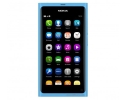
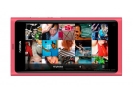
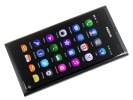
And you can easily see why: a spanking new OS based on some pretty impressive (and novel!) concepts, sleek unibody design, some decently powerful hardware (even if the N9 missed the dual-core train) and that magnificent 3.9" curved AMOLED of FWVGA resolution is a package that's hard to resist.
We got our hands on this baby today, and although our meeting was brief, it was enough for it to earn a special place in our geeky hearts. The Nokia N9 is an excellent device based on an exciting UI concept and boasting some sleek hardware. But what casts doubt on it is the claim that it represents a dead end in the smartphone tree of evolution.
But let’s not get all emotional now, the thing isn’t even on the market yet. And it looks like the right thing to help Nokia through the hard transition period in the second half of 2011. What we know for sure is we would love to have more whence this came from.
Here are the key specs of the Nokia N9 but remember these numbers tell only half the story:
Nokia N9 at a glance
General: GSM 850/900/1800/1900 MHz, UMTS 850/900/1700/1900/2100 MHz, HSDPA 14.4 Mbps, HSUPA 5.76 Mbps
Form factor: Touchscreen bar phone
Dimensions: 116.5 x 61.2 x 12.1 mm, 76 cc
Weight: 135 g
Display: 3.9" 16M-color FWVGA (480 x 854 pixels) AMOLED capacitive touchscreen; Gorilla Glass, anti-glare polarizer, curved display, multi-touch input
Chipset: 1GHz Cortex A8 CPU, PowerVR SGX530 GPU, TI OMAP 3630 chipset
RAM: 1GB
OS: MeeGo OS, v1.2 Harmattan
Memory: 16/64GB storage, no microSD slot
Camera: 8 megapixel auto-focus camera with face detection, touch focus and geotagging; HD (720p) video recording at 30fps, LED flash, front facing camera, video-calls
Connectivity: Wi-Fi a/b/g/n, Wi-Fi hotspot, Bluetooth 2.1, standard microUSB port, GPS receiver with A-GPS, 3.5mm audio jack, TV-out, NFC
Misc: Polycarbonate unibody, built-in accelerometer, proximity sensor, uses microSIM cards
On paper, the Nokia N9 looks like solid, if not spectacular. As soon as you set eyes on the real thing though, there's no mistaking a smartphone that will reach for the top rather than settle for anything less.

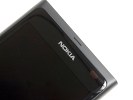
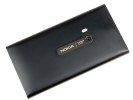
The premium finish and the outward curved screen are nothing short of outstanding. And the great news is that the good impressions don't end with the exterior. We were pleasantly surprised by the MeeGo Harmattan platform and starting to doubt whether switching to Windows Phone 7 was the only option available to Nokia.
There's a time and place for that discussion, and they are not here and now. We know you are as eager as we are to see what the Nokia N9 is really made of. Join us after the break for the hardware checkup.
Design and construction
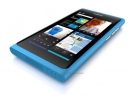
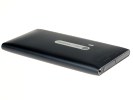
The bad news - in terms of build and finish - is that the Nokia N9 body is made of plastic. The great news is that it's a unibody made of premium-quality hard plastic (polycarbonate) so we don't think too many people will mind. In fact, the N9 is one of the hottest looking smartphones we’ve seen this year. A handset to be seen with, no doubt about that.
It also looks extra sturdy so dropping it wouldn't be as heartbreaking as if another handset is involved. Even more, the Nokia N9 seems to be the first handset with a non-painted body. No such thing as chipping off the paint anymore, the color of the phone is the color of the plastic it's made of. And even if you do manage to scratch it, you won’t see another color underneath.
A magnificent display
Cleverly designed as the body might be, the Nokia N9's main attraction remains the 3.9" curved FWVGA AMOLED. If you have been keeping track, you would know that the previous generation Nokia AMOLEDs have been one of the most impressive displays in the mobile world to date.
Their only shortcoming was that they were only coming in nHD resolution, which is some way behind the market’s best. On the N9 though, it is one of the most impressive displays we have seen. The Samsung Galaxy S II might be offering a few tenths of an inch of extra surface, but this unit is perfectly able to match its image quality and even throw some extra pixels in.
And indoor image quality is by far not the only impressive part about the Nokia N9 screen. Taking it outside only solidified our belief that this display is among the finest pieces of hardware developed by Nokia.
Not only does the screen remain visible in the sun, but its colors also retain most of their punch. The anti-glare polariser that Nokia has installed on top is certainly working well as the N9 is probably the least-reflective screen we have seen.
And the impressive marks continue into usability. Not only is the Nokia N9 touchscreen large and super sensitive, it is also curved outwards to make swiping gestures all the more natural. Plus, the display underneath is basically glued to the Gorilla Glass on top, which makes it look almost as if the icons are painted on the surface of the handset when you look from an extreme angle.
The rest of it
Having covered the body and the display, there really aren't that many things left to comment on the Nokia N9 hardware. Nokia makes a proud point with the absence of any buttons whatsoever on the front. Let us tell you up front, there aren’t that many on the sides either.
To make the transition to full-touch easier Nokia made the stripe around the display touch-sensitive too and added gesture controls that start there.
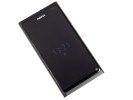
The functional elements on the front are the earpiece and the proximity sensor (in the upmost part of the front panel) and the video-call camera unusually placed in the lower right corner. We will have to spend some more time with the N9 to see how if new position works better than the old one, though.
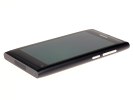
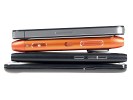
We move on to the Nokia N9 right side and the only two hardware buttons that you are going to find. You get a decently usable volume rocker and a power key. In reality, Nokia N9 could have gone without these two either as they have their on-screen alternatives (yes, even the power/screen unlock button is redundant here).
The opposite side of the Nokia N9 is completely bare, while the bottom features the loudspeaker grill. The microphone pinhole is also supposed to be at the bottom, though we couldn't spot it so it might be under the same grill as the speakerphone.
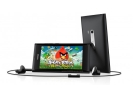
The Nokia N9 top features the 3.5mm audio jack, the microUSB standard port and the microSIM slot. This makes the Nokia N9 only the second smartphone to feature a microSIM slot after the iPhone 4. It's certainly not the most convenient solution for a number of reasons, but it will probably be slightly beneficial in the long run. The micro-sized SIM cards will probably one day become a standard and manufacturers will be able to save about 0.1 cm3 of volume for each handset. We are just not quite sure yet if it's worth it.
We complete our tour at the back of the Nokia N9, where we find the 8 megapixel camera lens and the LED flash. We found out that the full resolution of the sensor is actually 8.7 megapixels, but only up to 8MP of those could be used at a time. More on that in the software part of the preview.
So filled with good impressions of the Nokia N9 hardware, we set off exploring the more interesting part, the MeeGo 1.2 Harmattan OS. It's all a small jump away.
User interface
Nokia N9 is the first handset to run on the MeeGo 1.2 Harmattan platform and it only comes two years after the last of the Maemo kind, the Nokia N900. The leap however couldn’t have been bigger.
Well, it appears that the wait has been worth it as MeeGo in its current version offers a is already a pretty cool platform. With no need of any hardware buttons and a real taste for multi-tasking the brand new OS is really innovative. You can check it out in action in the following video.
Add to that the impressively novel swipes navigation (a swipe starts off the edge of the screen like on the BlackBerry Playbook) and centralization of everything in a total of three homescreen panes, and you get one neat mobile OS. You can check it out in action in the following video.
You see what we are talking about? No need to press the power key - you can unlock the screen by simply double-tapping on it. And a back button? Well why would you need it if you can just swipe from edge to edge and be back to the app drawer or task manager.
If you slide the lockscreen up a bit, it reveals four customizable shortcuts. A nice touch, indeed.
When you are past the lock screen, you get to the three homescreen panes. Now don't think of them as homescreens in the traditional sense of the word as they are everything but traditional. Instead those are just the three panes that you revert to when there's no app running.
Here's the deal with them - the first pane holds all your notifications (including social network updates), the second one is your app drawer, where all the installed apps reside, and the last screen is the multitasking cards pane. Here's a brief look at each of them.
The events screen gathers all your notifications, including the call log, messages, social network updates, etc. There's also an indication of the current weather conditions in the upper right corner, which you can click to access the detailed forecast for the coming days. Clicking on any of the notifications sends you immediately to the app that triggered it, so you can do something about it immediately.
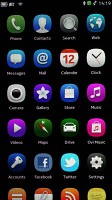
Next there's the app menu, which is a plain list of icons representing all the applications installed on your N9. There's no grouping of any kind at this point, be it categories or folders, but you are free to rearrange the icons as you see fit.
To enter edit mode you just press and hold one of the icons for a couple of seconds. In that edit mode you are also allowed to uninstall apps by clicking the red cross in their upper right corners. You should bear in mind though that you can only uninstall the apps you have installed and not the preinstalled system ones.
Finally, we came to the multitasking screen, where you see a neat grid of apps that are currently running on your N9. The two view modes (2x2 grid or 3x3 grid) are alternated by a pinch-zooming gesture.
If you have more applications running than can fit on one screen, you can scroll the list of thumbnails to get to the one you are looking for. Normally, you wouldn't need to do that though as the most recently opened apps appear on top of the list.
An interesting feat is the browser behavior, which adds a thumbnail for every page you have opened so you can manage them straight from the task manager. It’s as if your browser tabs and history are all integrated in the task switcher.
Everytime you exit an app it doesn't actually close but is minimized to the task switcher. Now depending on the app it would either be suspended or it will keep running in the background. Either way, it will resume from exactly where you left it when you reopen it by clicking its thumbnail.
If you run into performance issues you might want to try and close a few of those apps for real. We didn't see any issues with a list of 12 thumbnails but heavy users will probably end up with more, so we shouldn't rule out the possibility.
Anyway, to close apps you just click and hold one of them until the red crosses appear. Along with them you will notice a close all shortcut at the bottom of the screen, which might come in handy if you need to free up all the available resources.
The final Nokia N9 UI element is a bit harder to spot. By clicking on the status bar above some of the screen you reveal a pop-up, which let's you quickly adjust volume, change your profile or switch off some of your N9 radios.
Applications
Naturally we won't be able to cover the whole app package that comes with the Nokia N9 but here are a few notes about some of the key apps.
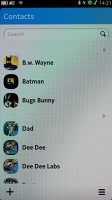
The contacts application is pretty neat looking with decent functionality and easy searching and scrolling. You can easily sync your Skype, Facebook, Exchange or just about any other contacts you can think of with your phone contacts. Skype integration, for instance, is pretty deep so you will even be able to start chats and VoIP calls right from the phonebook.
Messaging is also pretty cool with the copy/paste functionally having one of the greatest implementations we have seen. To mark text you just swipe your finger over it. The copy and cut shortcuts appear automatically and after you pick the one you need all you need to do is hold over the field where you need to paste the text and voila.
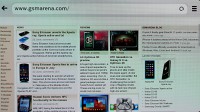
We already told you about one of the features of the browser, but here are a few other points about it. Its startup screen represents a list of your most visited websites, which is pretty convenient - it certainly saves quite a lot of typing and bookmarking. There's also an option to store a bookmark in your apps drawer with a dedicated icon. The browser’s default search page is Bing, but you can change it in the Settings menu.
Next, the Nokia N9 packs a universal search, which is mandatory for any modern day smartphone platform. It's pretty quick and it will locate any kind of content on your phone - from contacts to music tracks. If the thing you are looking for is nowhere to be found locally, you also get the option to initiate a Google or Bing search.
The camera interface is pretty cool, though it could have probably offered more settings around the viewfinder. Still, you get plenty of functionality, a Carl-Zeiss certified lens and a sensor that can capture 8 megapixel stills in 4:3 mode, or 7 megapixel snaps in 16:9 or 3:2 mode.
The camera interface itself is quite neat as you can see from the video above. Functionality is there too with touch focus, face detection and geo-tagging all on board. If Nokia gets the image quality part right than the N9 will certainly be on most cameraphone lovers' shortlists.
Finally, a mention about the NFC functionality of the Nokia N9. We were pretty impressed by how cool that works - you can use it for ultra fast Bluetooth pairing and identification to another NFC-packing smartphone. Here's how that works on video.
The NFC functionality can also be used for pairing a Bluetooth handset, or a portable speaker with the N9. We got to see a real-life demo of how it works - you just dab the handsfree against the handset and they automatically connect. Repeat and they disconnect - it doesn't get much simpler really.
First impressions
We would kill for a little more time with the Nokia N9. We would've liked to feast our eyes on the gorgeous AMOLED screen and handle the impressively sleek unibody just a little bit more. What we don’t need is further proof of the MeeGo and N9's great potential. It's good to know Nokia hasn't run out of fresh ideas as we were starting to fear recently.
There is plenty of innovation in terms of both hardware and software in the Nokia N9. The non-painted solid unibody, the top-notch AMOLED, the cool swipe gestures and the unmatched multitasking are just some of the features adding to the N9 hype.
It's now up to Nokia to capitalize on that and help MeeGo make the leap from a hot prospect to a serious source of income. It won't be easy as they will need to get the attention of developers and fill the few remaining gaps in functionality before they can even begin to catch up.
Let's hope that Symbian has helped Nokia learn a lesson and this project will be better managed. The Nokia N9 is just too hot to be left to gather dust on the shelves. And we are really hoping that Nokia won't ditch it in the gutter after it serves its role of a transition period high-end product, but will try and build on it.
The Price ????
Review Spesifikasi dan Harga Nokia N9---


0 komentar:
Posting Komentar